Friday, May 19, 2017

The Curse of the Post Amtrak World Part Duex


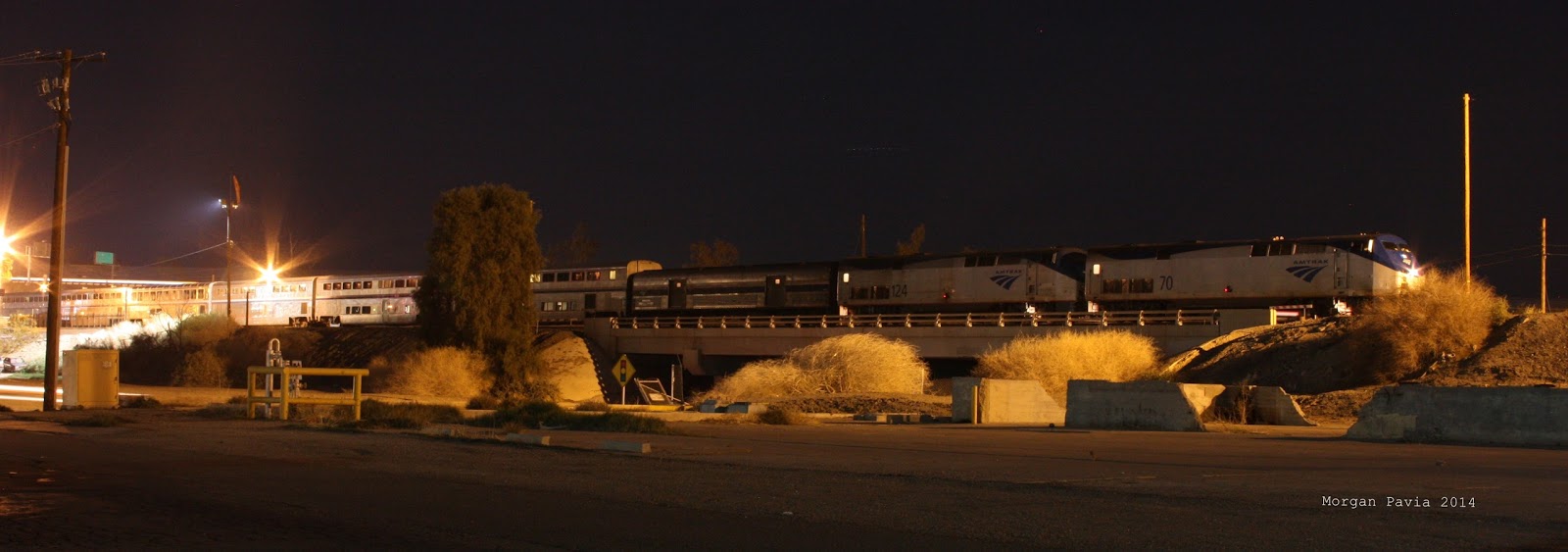
The eastbound Sunset Limited makes a station stop in Yuma, AZ circa 2010. Morgan Pavia Photo
If you recall in a previous post I discussed the genesis of Amtrak and gave a rough equipment history. In this post I am going to discuss specific trains that I will possibly be modeling, I listed three Amtrak trains in the previous post: The Sunset Limited, The Southwest Chief/ Southwest Limited/ Super Chief, and the Desert Wind.  Since I would like to model Colton crossing as working crossing that possibly brings the Chief and the Desert Wind into play as they ran on ATSF lines, more on that later.  As I stated previously, I make no claims to being an expert on this particular subject so any feedback or corrections are welcome. 

The Sunset Limited on the other hand traverses the entire portion  of the proposed layout with the exception of the Gila line between Wellton and Tucson.  While the train uses the Gila Line today, in the Southern Pacific days aside from at the very end, it traveled to Tucson via Phoenix.
Amtrak's Sunset Limited runs from Los Angeles to New Orleans and gets its name from the Southern Pacific train of the same name that traversed the same route.  At one point the train terminated in Orlando Florida making it the only true transcontinental passenger train and while I do not know when that service began I know Hurricane Katrina put an end to it.  Interestingly enough the two portions of the route that no longer see train service are also the only places serious wrecks occured; Big Bayou Canot near Mobile Alabama 09/22/1993, and Palo Verde Arizona, near Phoenix 10/11/1995. 

The Arizona wreck is of importance here as it occured on a part of the line that may be modeled during the timeframe I am interested in.  This wreck was also an act of sabotage as the track was deliberately taken out of gauge by an unknown party. The method used was so similar to that used to derail the City of San Francisco in the 1930's (also occuring on SP rails) that according to a post on the Southern Pacific Yahoo group the FBI interviewed all members of the Southern Pacific Historical and Technical Society  that resided in Arizona.  Although the wreck wasn't the stated cause around eight months later the Sunset was rerouted to the Gila line and less than a year later SP ceased to be. 
 
Another reason I bring both wrecks up is that we can glean information from the accident reports if they have been released (the AZ wreck is still an ongoing investigation so I am not sure on that one).  As stated in an earlier blog post NTSB reports are thorough and the report would contain detailed consist information for the train including car type and position of each car in the train.  This would tell us what the usual Sunset looked like in that year which will make acquiring the required models easier.

According to my 1981 employee timetables for the Los Angeles and Tucson Divisions the Sunset was a triweekly train (Train #1 westbound and train #2 eastbound) that traversed the line over night.  Like all other Amtrak trains it started life as a conglomeration of cars from different railroads.  I do not know when Amtrak started assigning their own crews to trains but atleast in the 1970's the operating personnel for the Sunset were provided by Southern Pacific.  The Sunset started out as an all single level train but by 1980 some of the former Santa Fe Hilevels had found their way into the consist.  I am not sure when this happened but I assume it was as the other western trains transitioned to Superliner equipment therefore freeing up the Hilevels to go to the Sunset.  In Late 1981 the Sunset began to see Superliner Equipment on occasion and by 1982 the transition was complete.  From my research it appears that the Sunset was one of the last western long distance trains to convert to HEP.  While most other Amtrak Superliner trains were powered by Amtrak's workhorse F40s through the 80's the Sunset was one of the few regular routes for the much maligned P30CH.
So what equipment is required to model the Sunset Limited? From my research I have found the following:

Early Amtrak (Rainbow and early Phase 1):

motive power it was what ever was available however former SP FP7s were the preferred power. The motive power was approximately 10 to 18 single level cars.

Mid to late 70's-1982

Two SDP40Fs with 10 to 18 single level. Former Santa Fe Hilevels used on occasion

1982-1990

Usually 2 P30CHs (usually being drug by atleast one SP unit due to a mechanical failure) and single level baggage followed by 8 Superliner and Highlevel cars including a dining car. The consist may or may not have included a lounge car.

1990s

What ever motive power was available. Photos of the Arizona wreck show a P32BHW onpoint with an F40 trailing and 12 car consist with one baggage car and a mix of Superliner and Hilevel equipment including a dining car and a lounge.

Now that I have discussed the primary passenger train on the layout lets discuss those that are mainly playing a scenery role. The Desert Wind  and the Southwest Chief at one point crossed the SP main at Colton on their way to San Bernardino however they did not originally follow this route.  Both trains originally were routed via Pasadena so other than detours these trains would not have crossed the SP at Colton until after they were rerouted.  The problem is they were not rerouted at the same time. An LA Times article states that the Desert Wind was rerouted in 1986 where as the general consensus on the internet is the Southwest Chief was not rerouted until 1993 when Metrolink took over the Pasadena line.  Also while the Desert Wind was discontinued in 1997, that is outside the modeled timeframe and so we do not have to worry about that.  So except for when I am modeling the late 80's or the 90's I do not need to worry about these trains.

So examining the consist of the Desert Wind (Train #35 westbound and Train #36 eastbound), we find much variation over the modeled period. Unlike its sister train The Pioneer, which I am more familiar with, the Desert Wind always seemed to have a decent length train.

1986-1990

Atleast 2 F40s usually followed by a baggage car and 5 Superliner and Hilevel cars including a step up Hilevel. However a picture from 1989 in the ebook version of Amtrak Across America (Morning Sun Books) shows 2 F40s, no baggage car only 4 Superliner/Hilevel cars including the step up car and 2 single level cars (possibly private cars) tacked on the end.

1990-1996

During this time frame the train was cut back from daily to triweekly and eventually running through to Chicago on the days the California Zephyr did not. It was during this time that the consist was increased to more resemble the Zephyr regularly including both a lounge and a diner.

The Southwest Chief  (Train #3 westbound and Train #4 eastbound) was only a regular sight at Colton for the last three years of the SP. This by far was the longest train of the 3. In fact when I saw it in New Mexico in January of 2000 it more resembled a freight train because it had just as many if not more express cars and Roadrailer trailers than passenger cars. However prior to the express freight period a more normal consist was usual.

1993-1996

What ever motive power was available between 2 an 4 locomotives followed by a single level baggage car and 8 Superliner/Hilevel cars including a lounge and a diner.  By most accounts this train was all Superliner 2 equipped by 1994.

As far as modeling is concerned I have a fair number of Walthers Superliner cars in phase 3 and phase 4 and plenty of locomotives so it should be no problem to model all three trains in the 3 years they all showed up at Colton (1993-1996). Having enough cars and locomotives for the late 80s could be a problem as I only have 2 Kato F40s, I would love to get some Rapido F40s but more importantly I need the P30CH which is not available in plastic as of this writing.  If someone releases the P30CH and former Hilevels in Phase 3 then I will probably have enough cars to model the Desert Wind and Sunset in the late 1980s. For the mid 1980s I still need to acquire passenger cars and locomotives in the phase 2 scheme however phase 3 was present so I might not need that many. For the 70's through the early 80s I need to acquire everything. Since this is my main time frame I definately need to acquire this equipment. I have 1 SDP40F on order and will order more as Athearn announces more variations. As for the rainbow period I also need to acquire everything however modeling pre1973 makes the physical plant of this section of railroad much different and so I might forego the rainbow era.

So as you see I really am a fan of Amtrak, the curse I refer to is merely that I do not have the knowledge base to model Amtrak like I do the SP.  Any time spent researching Amtrak to gain a better understanding is time not spent researching the SP, building models or designing the layout.  Not that I am complaining but Amtrak is like a shiny object to me and it is easy to get distracted, but that is all part of this journey. So lets enjoy the journey, we will get to the destination soon enough.

Thursday, May 11, 2017

The curse of the post Amtrak world


Amtrak #304 waits with the eastbound Empire Builder at Everett WA in the mid 1990's   Morgan Pavia Photo


When I came up with this post idea I did not realize that the very existence of Amtrak would be an issue. To give a peak behind the curtain so to speak I usually have a couple posts in various stages of completion at any given time.  Most of these "draft" posts are no more than a descriptive title to remind me of a good idea I had for a post that I did not have time to sit down and write on at that instant, this post is an example of that. Sometimes I even use these draft posts to remind me of an avenue I want to research in regards to the YPG lines. 


So what do I mean by a post Amtrak world? I mean anything after the inception of Amtrak so I suppose I could have called the post the curse of the post Rail Passenger Service Act of 1970 World but it just didn't have the same ring to it.  As I am no expert on Amtrak, I should note that most of the information contained here came from other sources over the course of the last 20 plus years most of it anecdotal, I have included my anecdotes and observations where I could.  However we all know how memories get over time and so I tried to verify specific dates etc... with a variety of online sources including Wikipedia (hey its on the internet it has to be true).  I have also provided hyperlinks within the text to items I could not provide a photo of out of my personal collection.


While my main focus is 1981 I do have interests from 1970-1996 so in essence I model the Amtrak era. So why is this a curse? The answer is simple this adds another railroad to the mix. Prior to Amtrak each railroad in the US provided its own passenger service, this meant that the locomotives and rolling stock were all on the same rosters as the freight equipment. It also meant that operating practices were the same.  Because of how Amtrak operates there can be many differences between the practices of the Freight railroad and Amtrak for example since Amtrak operates over multiple host railroads it is possible for crew change points to be different from the freight railroad. 

Most importantly it means having to research a whole other railroad where information will not be found in the same place as similar information from the freight railroad. For example when setting the modeled year at 1981 I can easily refer to Strapac's Diesel Locomotive Compendium Volume 2 to determine what locomotives I need on my roster for the SP, where as for Amtrak it is not as clear cut.

There is a possibility that counting Amtrak, four  railroads will be featured on this layout, and while the level to which these railroads is represented remains to be determined, rosters for each railroad in a given year still need to be determined.  This also gets interesting in that while the freight railroads might have tried to restrict locomotives and cars to certain terminals, some of Amtrak's equipment is definitely regional.


Depending on how the representation of Colton Crossing turns out there could be between 1 and 3 Amtrak name trains represented each with westbound and eastbound trains. These trains are:


1. The Sunset Limited (LA to New Orleans on the SP)
2. The Southwest Limited/Southwest Chief  (LA to Chicago on the Santa Fe)
3. The Desert Wind (LA to Salt Lake City on the UP (ATSF))


Each of these trains has different consist requirements and featured different equipment over the years. For example when steam heat was being phased out in favor of Head End Power (HEP) not all the trains transitioned at the same time. Figuring out these transition dates is key as it not only effects that specific train but there is a domino effect as equipment gets bumped off a given train it has a tendency to show up on other trains using the same terminal, in this case LA.

So lets start with a general discussion of the equipment used by Amtrak over the years starting at inception in 1971 and ending at the end of my modeled era in 1996. I am only discussing equipment that would have been present in the modeled area so switchers, diesels captive to other regions and electric locomotives will not be discussed here. Truly the 70's were very formative years for Amtrak as the company took delivery of most of the equipment that would serve it for the next two decades.


1971


This is Amtrak in its infancy, affectionately referred to by fans as the rainbow era because of the many different paint schemes present on some trains.  Amtrak started out life with a motley assortment of cars and locomotives acquired from railroads that joined. It should be noted that some railroads such as the Denver Rio Grande and Western, did not initially join Amtrak and continued to operate passenger service on their own. 


This era would seem to be a modelers dream as in theory cars could be acquired and run together from many different railroads based on the modelers like or dislike of a livery. However most the cars tended to stay in certain regions and some trains even managed to operate with matched consists.  At one point Southern Pacific even restricted Amtrak to only use former SP dome cars on SP rails due to clearance concerns. During this time steam heat was still the norm.


1973-1974


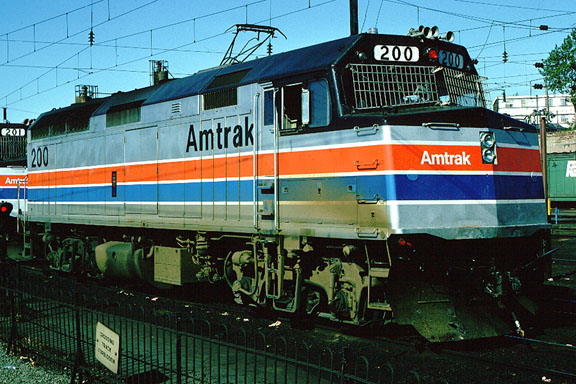
During this time frame Amtrak took delivery of 150 SDP40Fs from General Motors Electro Motive Division (EMD), these were the first new diesels that Amtrak took delivery of. The SDP40Fs were delivered in Amtrak's Phase 1 livery complete with pointless arrow logo. Some fans refer to this as bloody nose because they had a red nose, however to avoid confusion with the SP paint scheme with the same moniker, I will refer to them as Phase 1 or pointless arrow scheme. Like the legacy equipment the SDP40Fs were equipped with steam heat. During this time frame the legacy equipment (at some point this equipment was given the classification of Heritage Equipment) was beginning to be repainted into Amtrak's new image. While some rainbow does still exist more uniformity is present.


1975


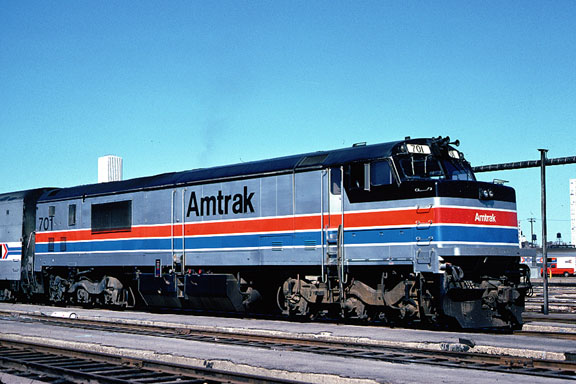
During this time, Amtrak took delivery of  25 General Electric (GE) P30CH locomotives, these locomotives were ordered after the first batch of SDP40Fs.  Nicknamed the Pooch this was the first American locomotive delivered with HEP and delivered in the Phase 2 livery with thick red and blue stripes separated by white pinstripes and no pointless arrow.


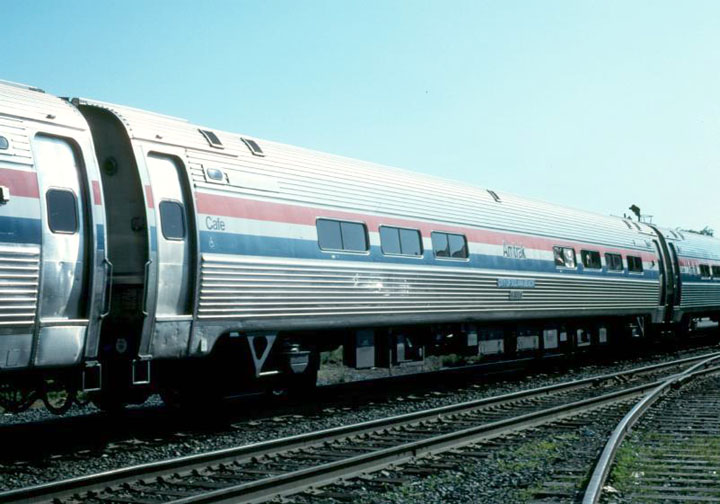
This is also the period during which the Amfleet cars entered service. Painted in Phase 2 and equipped with HEP these cars were designed for short haul and commute service and while these cars would not likely have seen revenue service on the majority of the modeled portion of the railroad the cars were used on the San Diegan and would have been deadheaded to and from LA on the end of the long distance trains for repairs.


1976


In this year Amtrak took delivery of 30 F40PH locomotives from EMD. Also delivered in Phase 2 paint and equipped with HEP these locomotives were originally intended for short haul runs but eventual won the role of Amtrak's primary diesel locomotive. The F40 with its 4 axle trucks also marked a departure from 6 axle trucks a practice which Amtrak continues today.


1979


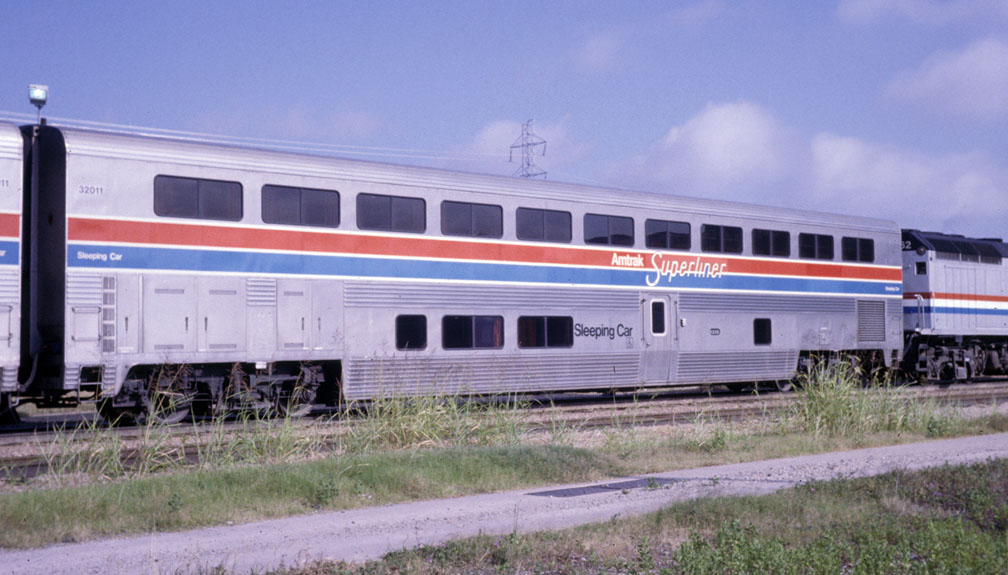
Since 1975 Amtrak had been taking  delivery of the Superliner cars which were also painted in the Phase 2 livery and equipped to run on HEP. Although the cars were on property they would not enter service until 1979 on the Empire Builder. Not all long distance trains were converted at the same time and trains were converted as equipment became available.

During the 1980's Amtrak continued to receive deliveries of F40PHs. It was during this time that most legacy units and the SDP40Fs were phased out.


1982


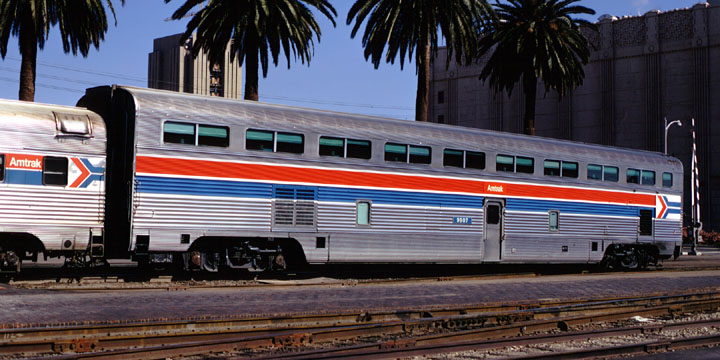
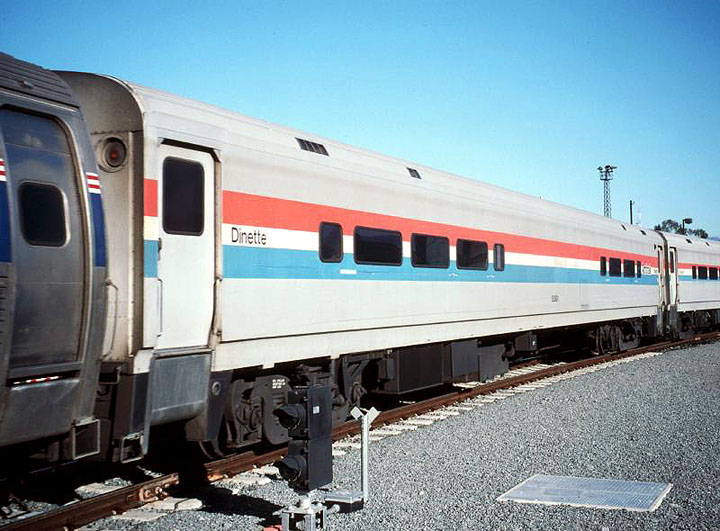
By this time Amtrak has gone whole hog on HEP and all new equipment is being delivered equipped with HEP. By 1982 I believe all the long distance trains in the west were equipped with Superliner cars. As Superliner cars were phased in the legacy equipment was phased out. Some of the cars that were in better shape were refurbished and HEP equipped and became the Heritage cars. The former Santa Fe Hi level cars were refurbished and upgraded to HEP as well and used in the Superliner pool. Some time in the mid to late 70's Phase 3 paint was introduced and by 1987 all previous liveries had been phased out.  Phase 3 while similar to Phase 2 consisted of roughly equal sized red white and Blue stripes and was Amtrak's longest running paint scheme. I also feel that aside from Phase 1 this is the most iconic livery Amtrak ever had.


1989


During this year the Horizon cars entered service. Like the Amfleet the Horizon cars were predominantly used on shorter hauls outside if the modeled area.  But also like the Amfleet cars they found use in short haul service out of LA and so would have deadheaded on a train to and from the car shops back east.


In the 1990's Amtrak was faced with replacing an aging locomotive and car fleet.  This was also a time where Amtrak was trying to improve its image and so some reinvention and expansion of service was ongoing, however so were cutbacks.  It was during this period when the P30CH was phased out completely and the transition away from the F40 began.  This era also coincided with the mega mergers of BNSF and UP swallowing the SP whole.  As a teenager I found this an exciting and interesting time to railfan.


1991


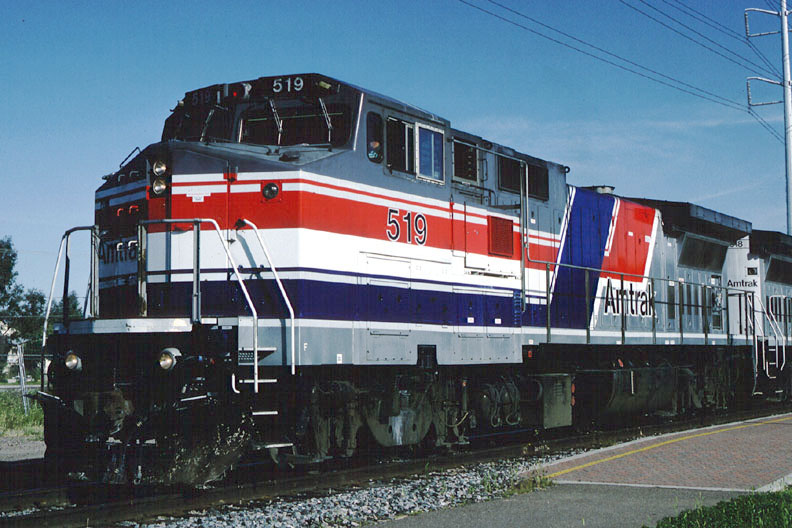
This was the year the Dash 8-32BHW also sometimes referred to as P32-8HW or B32-8HW were delivered.  These locomotives were a stop gap measure meant to hold Amtrak over until the Genesis locomotives were delivered.  Essentially these were freight units with added HEP and they looked it. These units were however delivered in a contemporary adaptation of Phase 3 and nicknamed Pepsi cans by railfans because of the similarity in colors. Personally I liked this livery and was sad when they were repainted into Phase 4 and later Phase 5.


Superliner 2 cars were also began being delivered in 1991. These cars built by Bombardier were upgraded versions of the Superliner cars as well as replacing some functions that the old Hilevels had performed such as the transition sleeper.  The cars were delivered in what would become the Phase 4 paint scheme and were quickly mixed into the Superliner pool.

Taken with a point and shoot with a light leak this photo illustrates both Phase 3 and Phase 4 paint schemes as the eastbound Empire Builder passes the Izaak Walton Inn in Essex Mt in 1994. The car on the left is an old Santa Fe Highlevel car reconfigured as a transition dorm.  The following two cars are newly delivered Superliner 2 cars.  Morgan Pavia Photo


1993


The GE Genesis series locomotives began arriving in 1993. The first Genesis models, the P40s (originally referred to as Amtrak Monocoque Diesel - 103MPH or AMD 103s for short), and featured a Phase 3 striping that faded toward the back of the unit. The idea was this scheme was supposed to make the stripes look like a waiving flag but I honestly do not remember it working. Probably for this reason and cost savings the scheme was abandoned on the P42s in favor of solid stripes.


P42 #18 and P40 #801 Waits on the mainline with the eastbound Empire Builder at East Skykomish WA circa 1997.  The passenger train is waiting for a BNSF Freight that stalled on the hill (if I recall correctly the train stalled in the Cascade tunnel),in the early days of the Dash 9s there were many growing pains on BNSF such as locomotives shutting down on the hill, some of this was due to BNSF under powering  trains with the Dash 9s on them.  The lead unit of the freight train in the siding has gone up to shove the stalled train through the tunnel. this photo perfectly illustrates the paint scheme differences between the P40 and P42.                                                                                                                         Morgan Pavia Photo
1994

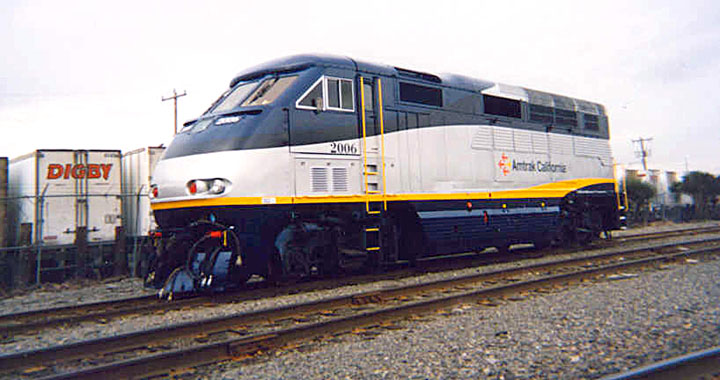
This year saw the delivery of the F59PHI which was used in regional service such as the San Diegan (later Surf Liner) Amtrak California Service and the Cascades in Washington and Oregon and painted accordingly. Although these locomotives were not regulars in long distance service the occasionally got  ferried between Los Angeles and the Shops back east.


1996


The P42s began arriving on scene, although very similar in appearance to the P40s they were delivered in Phase 3 with solid stripes. These locomotives also received one or two digit road numbers which made them very easy to spot.  While P42s did eventually start receiving road numbers in the low 100s, I do not believe that this occurred prior to the end of 1996.

One thing I did not cover so far is test equipment. Most of the time these were one time publicity movements or ferry moves although there was talk at one point of a Los Angeles to Las Vegas Talgo service. Despite this talk I don't think it went much beyond a few demonstration runs and as I remember the Talgo train set spent its time in service on the Cascades still painted in the colors of the proposed Vegas service.


Sandwiched between two F40s The Talgo demonstrator train set pauses at the new Bellingham depot in the late 1990's.
Morgan Pavia photo


The various high speed train sets that made the rounds in the 1990s such as the Talgo pendular, were not a new phenomenon. In the 1970s high speed trainsets such as the turbo train made the rounds of the US as well. However just like the modern day Talgos these trainsets found niches elsewhere and therefore wont be discussed any further, although there is a picture out there of the Turbo Train at the Phoenix Depot back in the 70's so if I come across a Rapido Amtrak version at a price I am willing to pay who knows.  I will continue the discussion of the curse of modeling Amtrak and considerations for roster and operations for the YPG lines in a future post, until then just remember it is a journey and have fun.

Friday, May 5, 2017

Artwork


This is another post I wrote while I was bored on an airplane.  I referenced it in a previous post and started out as a serious post, however those that know me know that while I am serious about the hobby I do not take the hobby seriously (We play with toy trains for crying out loud) and since the majority of this was written at the end of march I toyed with it being an April fools joke.  Years ago Tony Koester wrote a trains of thought column about how he was dismantling his HO Nickel Plate Railroad and switching scales to G scale. personally I found the article brilliant and thought a post about me getting out of the hobby and becoming a railroad art aficionado would be a good tongue in cheek post for April 1st and I was going to lead with the Photo below. 


Truly one of my favorite paintings, I picked it up on a trip to Disneyland the Christmas before my daughter was born.  After our last move it sat hidden away and she had not ever seen it, during this time it managed to come out of its frame and so when I took it get reframed she saw it and loved it too.  Needless to say it is now on loan to her.


Well April 1st came and went and so now instead of trying to make a humorous post I am back at trying to be serious as I got tired of looking at a half finished post on my drafts list. So here it is.


Previously I discussed the number of books that have been purchased in pursuit of model railroading. These books offer a huge amount of information and inspiration that can be used towards building our layouts. This is not to say that books are the only non-model or tool purchases we should make. Of course photographs and slides are also valuable,  but what other sources of inspiration can we find out there? What about wall art? By wall art I mean items that are meant to be hung on the wall and took some effort to produce. A railroad lantern or other artifacts could be hung on the wall but I feel these are classified more as décor, than art.

I break wall art down into two categories first one is paintings and drawings and the second is other art.  Lets start with the other category which by its very nature is a catch all category.  In my "I love Me room" (I do not yet have a dedicated hobby space but I do have a room that is mine to eventually do hobby work in that also will double as an office and the room I keep all my work gear in,  currently it doubles as Storage room B) I have several examples of the other category. The first is metal work, on one of our trips around Arizona, I think it was in Tombstone, my wife managed to find a metalwork representation of a steam locomotive. She procured it and gave it to me for our anniversary (hey she tolerates the hobby even if she thinks it can be silly).

The second thing under this category is cloth work. Once again my wife managed to stumble across something during our travels and bought it for me, I believe they are swatches of fabric with a railroad theme that have been framed in a rustic wood frame, the scenes represent Colorado narrow guage and are enjoyably to view. Now someone might ask if this is really art? Well someone had to create the original artwork.

The final items in the other category is my collection of Yuma produce lables. Once again someone created the original artwork. Agriculture is King in Yuma and these labels harken back to its Zenith, a bygone era of steam and early diesel locomotives and iced PFE refrigerator cars. I currently have labels that are mostly from vegetable crates, mostly lettuce which is fitting since Yuma is the winter lettuce capital of the United States, but I hope to soon acquire some labels from citris and melon crates. Some of the shippers included in my collection will even be represented on the layout. Also when I get a layout space I plan to move these into the train room to help set the mood and give the layout a sense of place.


My produce crate label collection.  Many agricultural areas had similar collections for whatever product they shipped out, I have even seen can labels for canned fish from the canneries in Washington State. My dad collects Wenatchee Valley apple and pear crate labels, if I was modeling Tehachapi it would be apples as well.


While I do not currently have any drawings railroad themed paintings are another story.  There are several different types of paintings out there such as oil, acrylic and water color to name a few. There are also many different levels of painting from the low end print to the high end original. In the middle there is the giclee and these are truly stunning at less cost than an original.  In my personal opinion, if you are framing these with a frame that has glass and not lighting them a print is good enough as many of the effects are minimized when behind glass.  For example I have seen giclees and originals that were individually lit and it looked like all the lights in the scenes were on.  This is an amazing effect for headlights and block signals, however as stated before it is lost if the work is behind glass and not lit, so i that situation the lower cost print will do nicely.  After all we are trying to save more money for models right?

There are many terrific railroad related artists out there, each with a different style and subject matter they specialize in. Everyone knows the name Howard Fogg and I do have one example of his work despite it being of a UP subject. The painting is called "King of the Hill" and features a Big Boy locomotive. I picked this one up when UP 844 came through town, so I can make an exception for subject matter.


I have two paintings of Amtrak as well the first is by Thorpe and features the Empire Builder crossing Sheep Creek Trestle in Glacier National Park. My dad models the Great Northern and before he settled on Stevens Pass he considered modeling Montana so we spent several family vacations in this area and it has a soft spot in my heart. The second is a Larry Fisher work also featuring the Empire Builder, entitled "The Rainbow". This painting depicts the Builder exiting the west portal of the Cascade Tunnel in Washington State (a location that I grew up railfanning) during the early days of Amtrak. For those who dont know this time frame was known as the rainbow era as most of the equipment was still in the liveries of the original owners making for some interesting combinations in consists.  Also if you look closely the car that is just exiting the tunnel and only partially visable is a Southern Pacific car.

My final two paintings are by John Winfield, I especially love his work as he specializes in railroads of the South and Southwest. I picked up these prints at the SPH&TS convention last year in Palm Springs and my only regret is I did not buy some others he had as well. The first painting is one I have coveted for years. I saw it in a catalogue but did not buy it and had been searching for it ever since, it features the westbound (northbound) Morning Daylight  lead by 4449 along the bluff at Gaviota, California. This is an iconic Southern Pacific scene and it shows the SP at its finest.  The other Winfield painting features the Eagle Mountain Railroad bringing a loaded ore train down to Ferrum to interchange the SP. Not only is this a gorgeous painting but it show cases an interchange I plan on modeling.


There are several more Winfields I hope to acquire over the next few years but I only have so much wall space in my 10x10 room (its really more like 8x10 as the closet sticks at least 2 feet into the room but the builder got away with some creative measurements to be able to claim the room was10x10). He does have one featuring U25's on Beaumont Hill, which hopefully I can acquire if he attends the SPH&TS convention in Santa Rosa this year. 


From left to right: Larry Fisher "The Rainbow", Top Center: John Winfield "Daylight #99 at Gaviota", Bottom Center: John Winfield "Kaiser Steel's Eagle Mountain Railroad", Right: Howard Fogg "King of the Hill", Far Right: J. Craig Thorpe "Glacier Morning"


So if you are looking for inspiration perhaps finding an artist whose paintings catch your fancy is just the ticket. Who knows what it will inspire you to create. Until next time remember its all about the journey and most importantly have fun.

Monday, April 24, 2017

3 steps forward 2 steps back

In the last post I talked about revising my goals and set out on a revised plan for the year. Well a few short days later I am having to re-evaluate these goals again. I wont get into the gory details as I feel I would be talking out of school, other than to state that change is inevitable when there is a change in leadership, and this is most assuredly true in the world of model railroad clubs. 

So the long and short of it is all the goals I had involving the club, are on hold until the dust settles.  I am in no way implying that I am metaphorically taking my ball and going home as I do enjoy the company of many of the members, I am just re-evaluating my situation and allowing the dust to settle before I make anymore goals or decisions involving the club.

One of the things that is leading to this re-evaluation is that the club voted to start construction of a permanent layout and depending on the route the club decides to go on trackwork I could be very busy over the next year as I am one of three guys that are advocating handlaying our turnouts. If we go that route my share would be atleast 15 #6 turnouts as well as anything else we might need. So on the bright side I will get to improve my turnout building skills but I might not have time for anything else. 

This decision also means that the modular layout, which is usually stored in an operational state where the new layout is being built, has been put in storage and whether it sees the light of day again is unclear at this time. A side effect of this is that until we get the track operational on the new layout that there is no where for me to run trains and test out any modifications and upgrades I make to any locomotives or rolling stock.  While I could still continue with the wheel and coupler upgrades I am currently also considering a reweigh as well. So until I decide on how I want to go about that and how to streamline the process so that the cars get shopped, re-weighted, and weathered and then stored in a box designed for storage in one shot, this process is on hold too.

Also I have hit a major snag on the YPG Lines and am having to visit the operational scheme a lot earlier than I intended.  The main reason for this is staging yard capacity and if if a staging yard of appropriate size will not fit then I will have to redesign the layout to accomodate one.  So until that is sorted out updates might be fewer and farther between.

That said I will still strive to update the blog atleast once a month and I am not above including some of the club layout construction in future blog posts. Hopefully by the end of next month I will have the issues with the YPG lines sorted out and be able to complete the planning of phase 2. But didn't I say that last month and the month before that. I just have to remember that this is a journey and sometimes even the priority trains have to go in the hole.

Tuesday, April 11, 2017

Re-evaluating goals AKA the First Quarter Report

I think everyone is familiar with New Years resolutions and how most people end up setting out on the first of the year with high hopes and motivation only to have this all peter out a week or so later. The same seems to be true amongst model railroaders and our goals for the year. Over the last week or so I have seen several blog posts dealing with having to refocus after life got in the way. Let me just come out and say it, sometimes life sucks and we have to adapt and overcome.  So here is my submission to the long list of model railroaders re-evaluating our focus after the first quarter of the year.

So lets start with where I have fallen short:

The building I am working on for my dad is no farther along than it was at the end of last year. The reason for this is I have reached a crucial element that has quite frankly overwhelmed me and I havent felt like putting the time in to get over this hurdle. It also doesn't help that I have been enjoying the journey of designing the YPG lines so much that I havent wanted to take time away from that to pursue side projects.

Model building has also fallen behind.  The biggest reason for this is financial. I have so much tied up in preorders of necessary locomotives and rolling stock right now that I need to be careful about expenditures from my hobby budget until after these orders have been filled. This has been the biggest reason I havent pulled the trigger on acquiring the needed shells and parts for either of my proposed locomotive builds. So the locomotive builds are on hold indefinitely. The best I can state is I will revisit this goal later in the year.

The bridge build has also been put on hold indefinately. The biggest reason for this is that through a combination of many factors, I did not get my hobby workspace cleared out enough to take on a build of that scale at this time. Also there was a possibility that a move could occur this last few months. While it does not appear that a move is imminent, the prospect of one is more of a reality than it has been previously.

Construction of TOMA modules is on hold for the time being as well. The biggest reason is that there is a project in my garage workspace that needs to be completed first, however the weather this winter has been less than optimal for working on projects outdoors.  Also as we entered the tail end of last quarter the outside temperature was already reaching triple digits.

So with all this doom and gloom, what has gone right?

The blog is the biggest success of the quarter as I am posting well more than my minimum one post a month goal. Thank you to all of you that read the blog and those that have commented either here or on facebook as the engagement with others was the primary reason for creating the blog. also the sheer number of people reading the blog and Facebook page encourages me to attempt to keep up with content.
Research has continued at a meteoric pace. I now have looked at 65 of 70 boxes of photos in the local archive and have developed leads to photos that might be in other collections.

Planning of the YPG lines has also moved along at a good clip I should be wrapping up the planning of phase 2 in the next couple weeks and start planning phase 3 shortly. The plan is still to try to complete the planning of the "million dollar track plan" by the end of the year.

A series of unplanned events

When I wrote the goals for the year in January there were many things I did not anticipate, nor could I anticipate them in some cases, but that is life. One thing I did not anticipate was my wife willingly letting me have my last day of vacation to go spend an afternoon visiting a layout. As I only get 1 to 2 weeks a year to see family I was surprised my parents went along with the idea as well, although my dad, being a model railroader himself, was not too hard to convince. There are two types of layout visits, the completed layout and the under construction layout. From a planning stand point I get more out of visiting an under construction layout than a competed one. I am not saying that visiting a completed layout is not enjoyable, but rather that most the educational points of a finished layout are covered over with the scenery we love. 

As I alluded to in the last post I recently had a chance to meet Mike Deverell and see his layout in person. While Mike has some beautifully done scenes, and they are impressive, a large portion of the layout is still bare benchwork.  There were a couple big take aways I got from this visit and a few Ah-ha moments.

The first take away was just how well a narrow shelf works, I have read about this concept but not seen it put to use other than bare benchwork.  One of the first scenes encountered upon entering Mike's layout space was a stunning bridge scene, and it is only about 12 inches deep. Those of you who have watched Mike's videos will know the scene, the bridge itself is a "simple" bridge over a small stream, but it grabbed my attention right away. I had to get right up to the benchwork fo notice that the scene was as narrow as it was. Everything from the foreground to the backdrop just blended so well, and Mike's technique for clouds was so subtle that I did not notice them until he pointed them out. The scene just worked! 

The second take away was setting. All the towns on his layout have station signs hanging over them, no need to take your eyes off the train to figure out where you are.  Also like the clouds the signs are subtle; there when you need to read them but blend in nicely when you are focused elsewhere. Mike also uses sound to set the scene; the layout is set in 1956 and when we walked in music from 1956 was playing. Like a movie soundtrack, the music was there but not overpowering and definately helped set the scene for railroading in the 1950's.

The ah ha moments were on design issues such as curve radius as an operating challenge, layout height as well as fascia track diagrams. Mike's layout is high by "normal" standards, but this high layout with a cantilever design made the aisles seem wider than they were and made it very easy for people to pass in the aisles. Mike's fascia mounted track diagrams not only show track arrangements at various locations, but also state what authority each track is under such as yard limits and CTC. Using curve radius as an operating challenge came to me as Mike talked about limiting certain cars to certain tracks. On the way to Mike's house we drove along the combined BNSF/Union Pacific mainline on the Tacoma waterfront and there was a sign limiting certain passenger equipment to a specific track. Therefore I can cheat on my minimum radius on sidings and restrict lomger equiement from these tracks and still be prototpical. This should also keep dispatchers and crews on their toes when scheduling meets.  I enjoyed meeting Mike and his family and learned a great deal that can be applied to my layout design.

The second unplanned event occurred shortly after I started making arangements to visit Mike. I called my dad about something and recieved a tirade about how he was done in the hobby, because everything quit working suddenly and he didnt have the time or the desire to trouble shoot the problem.  So one day while I was up visiting, I took it upon myself to trouble shoot his layout for him. Turns out all the wailing and gnashing of teeth about new fangled technologies boiled down to a problem as old as model railroading itself; dirty track and dirty wheels. So I set about cleaning his track and locomotive wheels.  Then to prove I was successful I had to perform the unenviable task of test running said trains (oh poor me). Everything was going well until I ran afoul of one of his two magic silver switches (if you dont know what I am talking about listen to more AML). This was however the first time I had actually run a train in over 9 years and doing so kind of made me want to get some of my ideas off the drawing board a little faster. It also made me realize that a large layout needs a plan for cleaning track especially if there are hard to reach places. For example my dads layout has a turnback curve over the staircase which meant cleaning that portion was not only a contortionist act, but a tight rope walk as well. So now I need to sit down and budget the funds to acquire the necessary cars for a track cleaning "work train".

The final unforseen event was the county fair. I knew the club was going to have a layout there but I did not think I would get much of a chance to run anything, especially since most of my models have been in storage since March of 2008. Granted the latout is a simple roundy roundy display layout so there wasnt much to do other than take the throttle and set it and forget it, but running trains is running trains. In all the previous clubs I have been involved in, only two trains were allowed to run at a show or open house and only equipment that had been checked out for operation prior. The first night of the fair I was asked why I hadnt brought anything to run, so I explained that I had not had a chance to tune up any of my equipment, which brought a loud laugh from the rest of the crew and they told me to bring some stuff and we could trouble shoot it there if a problem developed.  I have to say I am enjoying this minimal drama approach to a model railroad club. Anyway this caused me to go through my storage and locate about two and a half trains worth of cars and some locomotives 3 dcc and 1 ABBA set of F units which were still dc. Other than a few minor issues and one bad derailment (stringlined a curve with 2 of my double stack cars) that lead to a bad order car my equipment performed flawlessly. Also since everything I brought was assembled from a kit and I had done the dcc installs myself it reminded me what I am capable of as a modeler.
So with all of this in mind I feel it might be important to re-evaluate my goals for the year. Although some of the original goals may still be met, I felt that adding a couple more cost effective and achievable goals might help me keep from getting frustrated and help me move on to my original goals.

Additional goal 1:

Go through all my storage bins and boxes and locate all my unbuilt kits and get them consolidated in one location. Since one of the biggest hurdles this year has been finding the finances for the hobby (as I finish this post I am in the waiting room at the auto shop for some unplanned maintenance) I can get some modeling done by building kits I already have as opposed to getting no modeling done because I am trying to scrimp and save to get the needed parts for a locomotive build.

Additional goal 2:

Assuming a move does not happen in the next year I will have the county fair to look forward to. Since it closed yesterday that means I have 51 weeks to get some trains ready to run. By this I mean two to three trainsets tuned up and ready. This will include:

1. Couplers changed to Kadee on all equipment (possibly scale heads)

2. Metal wheels on all cars

3. Covert those F units to dcc with sound (possibly motor the 2 dummy B units) possibly upgrade the decoders and lights in the other locomotives I took this year

4. Weather all the rolling stock to some degree

5. Proper storage and transport system for the rolling stock (possibly Fast Tracks Freight Crates).
The first locomotive I ever attempted to super detail (while in college) heels into the curve on the Yuma Model Railroaders layout at the 2017 Yuma County Fair (module by Lee Stoermer, Morgan Pavia Photo)

I figure if I can stay on pace with what I am already doing and complete these additional goals then I can rule this year a success even if I do not complete all of my original goals. Remember this is a journey and sometimes you have to take the fork in the road.

Sunday, April 2, 2017

Scope and Scale

Well here I sit bored on a flight to Seattle, I was going to listen to A Modelers Life on the flight but my wife forgot her headphones and so being the good husband I am she is using mine.  But I digress, this is supposed to be a blog on model railroading not a travel blog. Although by the time I post this my travels will have taken me to see Mike Deverell's Colorado Front Range Layout. I am looking forward to not only meeting Mike, but getting to see his fine layout in person.  For those of you not familiar with Mike's work, he has a Youtube channel where he provides layout updates and instructional videos. You can find his youtube channel here.

Mike's layout is in an out building which is the route I want to go however his building is significantly smaller than my proposed project and this is one of the one reason I wanted to visit, to see if there is any way I could conceivable shrink the footprint of the YPG lines and still maintain the feel I am going for. While I am not saying I will shrink the layout alternative ideas do still intrigue me, for instance years ago I developed a track plan for the Somerton Branch that would fit in a spare room we had, however I was never truly happy with it and, a move made it a non-starter.

Recently, I have had conversations with a couple model railroaders who I respect the hell out of. The first being my dad who as I might have mentioned before models the Great Northern electric operations  over Stevens Pass in 1955. His layout is in a roughly 20' x20' room over the garage but his useable space for a layout is less as he has carved out a roughly 4' x 15' alcove for his workshop and staging. His main layout is HO but he also has loops underneath for Scale O, O27 and S Scale.  He and I were discussing some of the maintenance headaches he has been having and how since he is now in his mid 70's he may have built too much railroad, especially since his helper monkey (me) moved 1500 miles away 9 years ago today.

My dad in his train room. The lower deck foreground is S and O27, the foreground top deck is HO. The lower deck in the background is Scale O with two HO decks.


The second individual is Jeremy Dummler, while I dont always single people out, I felt I should just so Jeremy knows I appreciate his being a straight shooter with me. For those who dont know Jeremy, he models the Yosemite Valley Railroad (thats Yo-Sem-It-Tee, not Yo-Sem-Might), yes you read that right, the same railroad his friend and MMR Jack Burgess models. If you get a chance, visit Jeremy's informative blog here.  Jeremy is also very involved with the LDSIG and serves as a research editor for their magazine, The Layout Design Journal. So when it comes to issues of design I do take what Jeremy says into consideration even if I dont follow it.

Jeremy and I were discussing staging yard size, as I had posed the question on the YPG Lines Facebook page "if there was such thing as too much staging?" Jeremy pointed out that a 12 car staging yard on both ends would be 22 trains originating in staging during an op session not to mention those trains that originate on the layout or in one of the other staging yards along the way. This means to have a full opperating session would require almost 30 crews not to mention dispatchers and yard masters etc... Also Jeremy pointed out that this would require over 100 locomotives and 400 freight cars. Truly a layout of epic proportion akin to something out of a Cecil B. De Mile movie although hopefully with out as many deaths (although if someone ever produces the Jim Lincoln dead in the weeds figure it will probably find a home somewhere on the layout).

So lets discuss the scope and scale of this layout. First the current track plan I am working on is what I call the million dollar track plan, where space is not an issue and budget is not an issue. This is my dream layout, the final product may be this, it may be greatly reduced but I doubt it will be larger. This layout is essentially 3 layouts in 1. Colton to Yuma is one Layout, Yuma to Tucson is another, and Yuma itself is a very respectably sized switching layout with industrial and branchline trackage. The idea is that these layouts could all operate independantly or as a unit depending on available crew size, although I still havent figured out the west end staging for the Tucson Division as my middle staging is actually between Yuma and Wellton, not at Yuma.  Then again I havent even started on planning for the line east of Yuma as I am still working on Phase 2 which is the line from Colton to Yuma.

The biggest issue I see with yard capacity is making sure all trains have a place to terminate. Perhaps instead of staging yards, I need to refer to them as receiving yards as these yards need to have the capacity to receive all the trains on the layout as very few terminate midway. This was a busy line especially during beet season and the perishable season.  In am still researching traffic volumes but 10 trains each direction that traverse the entire layout does not seem too unreasonable for a full operating session. There would also be 3 to 5 trains originating at El Centro, 2-3 each direction originating at Phoenix, possibly a copper train originating between Phoenix and Tucson, the Iron ore train originating at Ferrum. Then there is the trains that originate at Colton or Tucson and terminate at a point on the layout such as Yuma, Phoenix, El Centro or Ferrum. Throw in a triweekly Amtrak on occasion and any other special moves and that is a lot of trains and we haven't even figured out how many trains originated at Yuma yet. Add the yard crews, one of which can work the Somerton Branch, a yard master for Yuma and possibly two dispatchers and thats a lot of operators. Oh I forgot helper crews because not every train out of Colton will run "single to Fingel". Yes the scope of the layout is huge and so the scale is huge as well (we will get into that in another post).

So why would I decide to take on this monstrous task, am I certifiable? Wait dont answer.  Here are a couple factors that have influenced my decision.

1. I personally do not like switching, but I wanted this layout to have something for everyone. What I enjoy is watching long trains get over the mainline. This is why most of the switching will be confined to the Yuma portion of the layout. I am also designing the layout so it can function with out cars being switched at Yuma. Even though there is a lot of square footage in the layout space I tried to minimize the number of switches and extra track to provide a long mainline run. I also tried to minimize turn back curves as the prototype, with the exception of San Timiteo Canyon is vitually straight from Yuma to Colton. The Tucson portion has more curves but most of these are just for gradual alignment change. Even if I reduced the scope of the layout to cover say just Beaumont Hill most these trains would still traverse the area modeled so it would not cut down the number of trains that significantly.

2. I am a builder and I do not want to reach the point of a finished layout too quickly.  Also by using the TOMA approach I can have a fully operational layout while I work on the next section. If I dont finish it all the layout will not suffer.

3. The final piece of the puzzle is that I face an early retirement. I have 13 years until I am eligible to retire, and 20 until mandatoty retirement at age 57. This means I am going to have a lot of free time a lot sooner than most of my peers. Also people in my line of work tend to die with in 6 years of retirement unless they have an active hobby to pursue. What better way to ensure that I can annoy my wife into my 90's than to have a layout that will take me that long to build.

So while I am aware of how large and crazy this layout is, I do appreciate feed back and will take peoples suggestions into consideration. So if I pose a question on the Facebook page feel free to comment, sometimes a few extra sets of eyes are all I need to get over a hurdle I have encountered. Remember this hobby is as much about having fun with the process as it is with enjoying the final product. This is a journey and like college I plan to make this journey last as long as humanly possible.

Wednesday, March 22, 2017

Coming full circle

There comes a day when you realize you have gone full circle and are right back where you began. In this instance I am not referring to physically but rather when we come back to what got us into the hobby. Now this could mean a couple things as discussed earlier I grew up railfanning the Stevens Pass area of Washington State in the late 80's and early 90's. Dont worry I am not changing my prototype, my dad models that area so if I ever need to scratch that itch I talk to him.

Its more along the lines that as I was researching the Sunset Route the other day something caught my attention and made me reflect on that seminal moment when I decided I wanted to seriously get into model trains. As I have stated previously it was Presidents Day 1989 and Southern Pacific 4449 was making a run over Stevens Pass to Wenatchee, Washington as part of the Washington State Centennial Celebration.


A later encounter with SP 4449 on BNSF rails east of Vancouver WA in Summer 2001. A few months later in response to the attacks of September 11 she was returned to her American Freedom Train colors.

So how do we get from the North Cascade Mountains of Washington State to the desert of Arizona? The answer is Facebook; more specifically a group on Facebook devoted to the Southern Pacific Railroad. It was in this group that some pictures of 4449 were shared from two of the occasions that she made an appearance on the Sunset Route in excursion service. This got me thinking how many times had the 4449 made an appearance on the Sunset Route, and specifically in the areas I am modeling, since she was restored to active service?

Counting directional movements and not roundtrips the number I come up with is six. Twice in American Freedom Train colors and four times in the classic Daylight colors. These apearances are as follows:

January 1976 eastbound as the American Freedom Train.

April 1977 westbound as Amtrak's Transcontinental Steam Excursion (return to Portland from AFT service).

1984 eastbound and westbound as the Louisiana Worlds Fair Daylight.

1986 eastbound to Ferrum for the filming of the movie "Tough Guys" with a westbound return trip.

Other than the lines in and around Portland, the Shasta Route and parts of the former Buington Northern, the Sunset Route provides me with more chances to run this locomotive than if I had modeled another locale such as Donner Pass or the Siskiyou Line. Even more interesting is I read on the internet (so it must be true) that for a period during the 1940's 4449 was based out of Yuma, so if I decide to backdate the layout to the 40's the 4449 can be a part of it. Of course most new locomotives were delivered via El Paso so they would have come through Yuma on their way west, but to be based out of Yuma provides many more opportunities to feature this famous locomotive and there is photo graphic evidence to back it up in the Barriger Collection:

We truly have come full circle.